
Practicepilot
Designing an AI-assisted coaching tool that helps volunteer coaches run better practices with less guesswork
Volunteer coaches are expected to run structured, engaging practices with limited time, inconsistent player skill levels, and little formal training.
Most rely on scattered drills, past experience, or improvisation. The result is inconsistent practices and low confidence in planning.
PracticePilot explores how an AI-assisted product could help coaches plan, run, and improve practices by turning a few simple inputs into structured, adaptable sessions.
Role
Product Designer
Scope
Product strategy, UX design, prototyping, concept validation
TIMELINE
1 Month
The opportunity
Youth sports are largely run by parent volunteers, not trained coaches.
Common challenges:
- Limited time to prepare practices
- Wide range of player ability
- Lack of structured planning tools
- Pressure to keep kids engaged and improving
Existing solutions focus on drill libraries, not decision-making.
Opportunity:Design a system that helps coaches structure practice time effectively, not just choose drills.
Approach
I framed PracticePilot as a decision-support system, not a content generator.
The goal was not to create more drills, but to help coaches:
- Decide what to run
- Structure time effectively
- Adapt in real-time
- Improve over time
This led to a core product loop that became the foundation of both the product and the experience:


Plan
Inputs → age, players, time, focus


Run
Live practice execution

Revise
Adjust drills, pacing, flow

Improve
Better next session output
Defining the MVP
To keep the product focused and usable, I defined a constrained MVP.
Inputs
- Player age / level
- Number of players
- Practice duration
- Focus area
- Available space / equipment
Outputs
- Structured practice plan with time-based segments
- Drill recommendations aligned to skill level
- Clear pacing and transitions
Platform strategy
- Desktop → planning and iteration
- Mobile → in-practice reference
Out of scope
- Full drill editing system
- Team history and long-term tracking
- Advanced personalization
- Multimodal inputs
This ensured the product prioritized clarity and usability over feature depth.
Key product decisions
01
Structure over infinite generation
Early exploration leaned toward open-ended AI outputs.
This created more friction, not less.
DecisionPrioritize structured practice plans with clear timing and flow.
ImpactReduced cognitive load and made plans immediately usable.
02
Design for real-world constraints
Practices are unpredictable:
- Kids lose focus
- Space is limited
- Time runs short
DecisionAnchor all outputs to real constraints like time, group size, and environment.
ImpactPlans felt realistic and executable.
03
Separate planning from execution
A single experience for planning and in-practice use created friction.
DecisionSplit the experience:
- Desktop for setup
- Mobile for quick reference
ImpactBetter alignment with actual coaching behavior.
04
Trust over novelty
AI-generated outputs can feel inconsistent or generic.
DecisionMake outputs structured, repeatable, and predictable.
ImpactIncreased confidence during real use.
Design execution
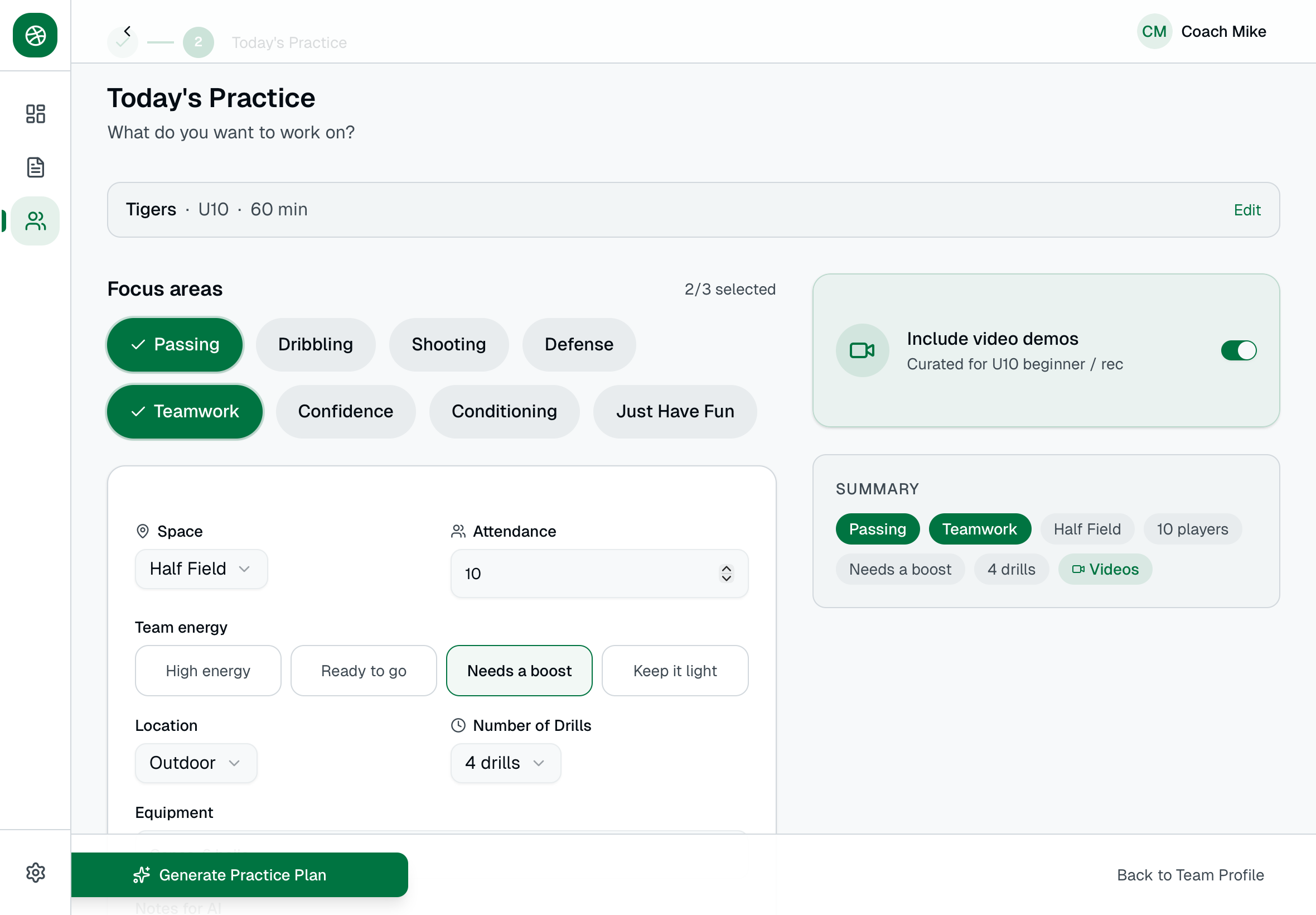
PRACTICE BUILDER
- Guided inputs replace blank-page planning
- Real-world constraints shape the output
- Summary confirms what the plan will optimize for
1
2
3
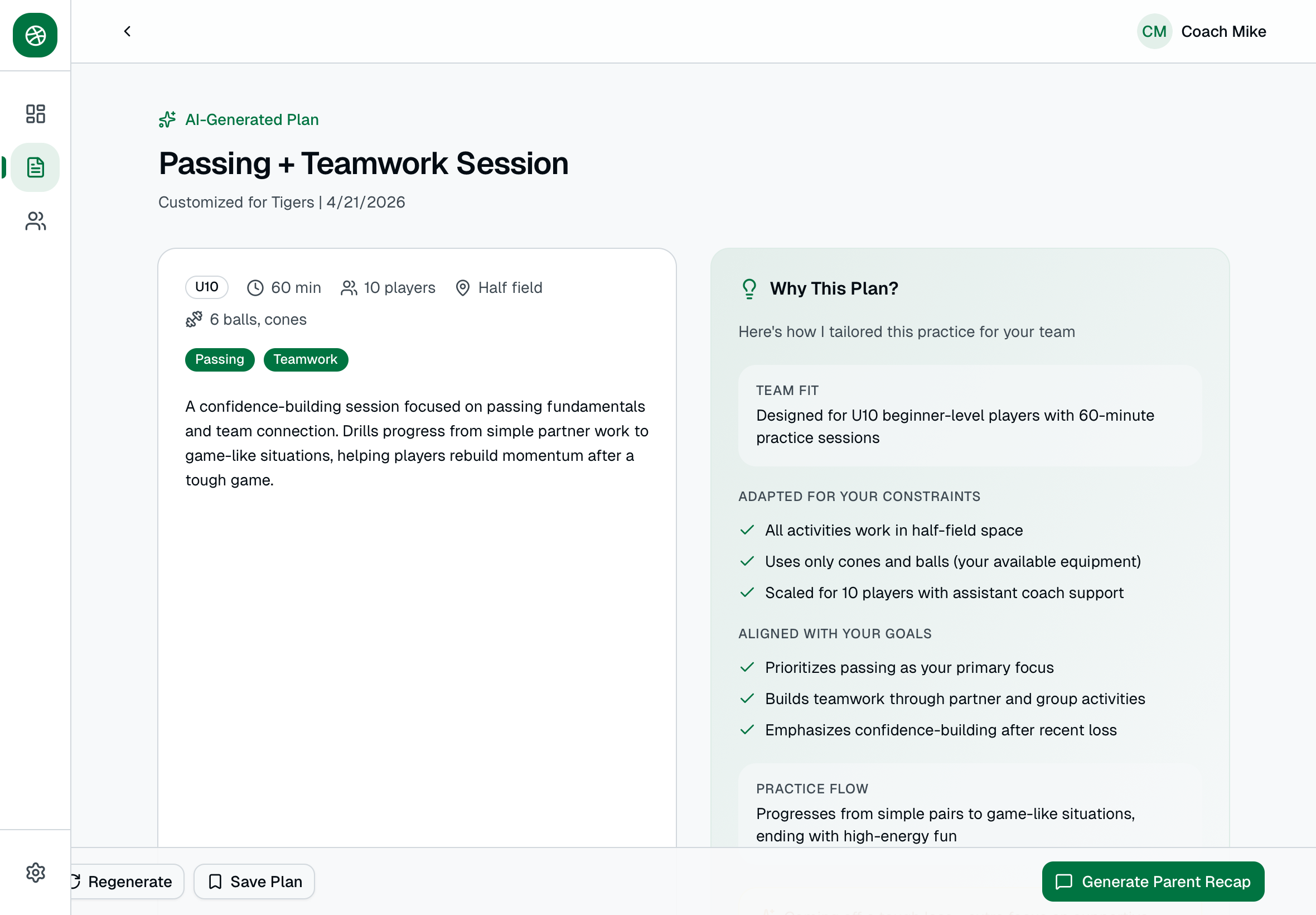
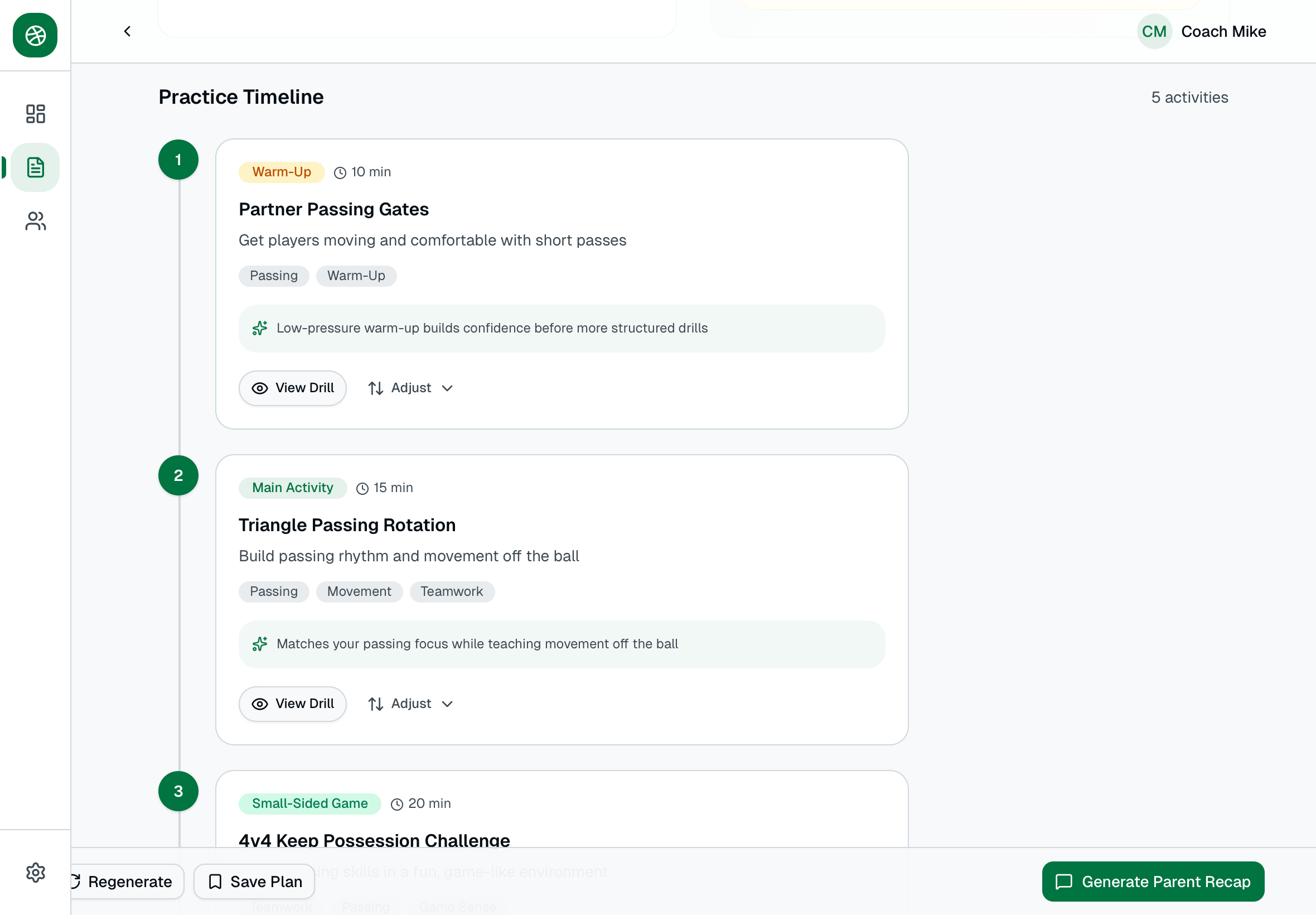
GENERATED PLAN
- AI output is structured into a real session flow
- Recommendation logic is visible, not hidden
- Save and regenerate preserve coach control

1
2
3
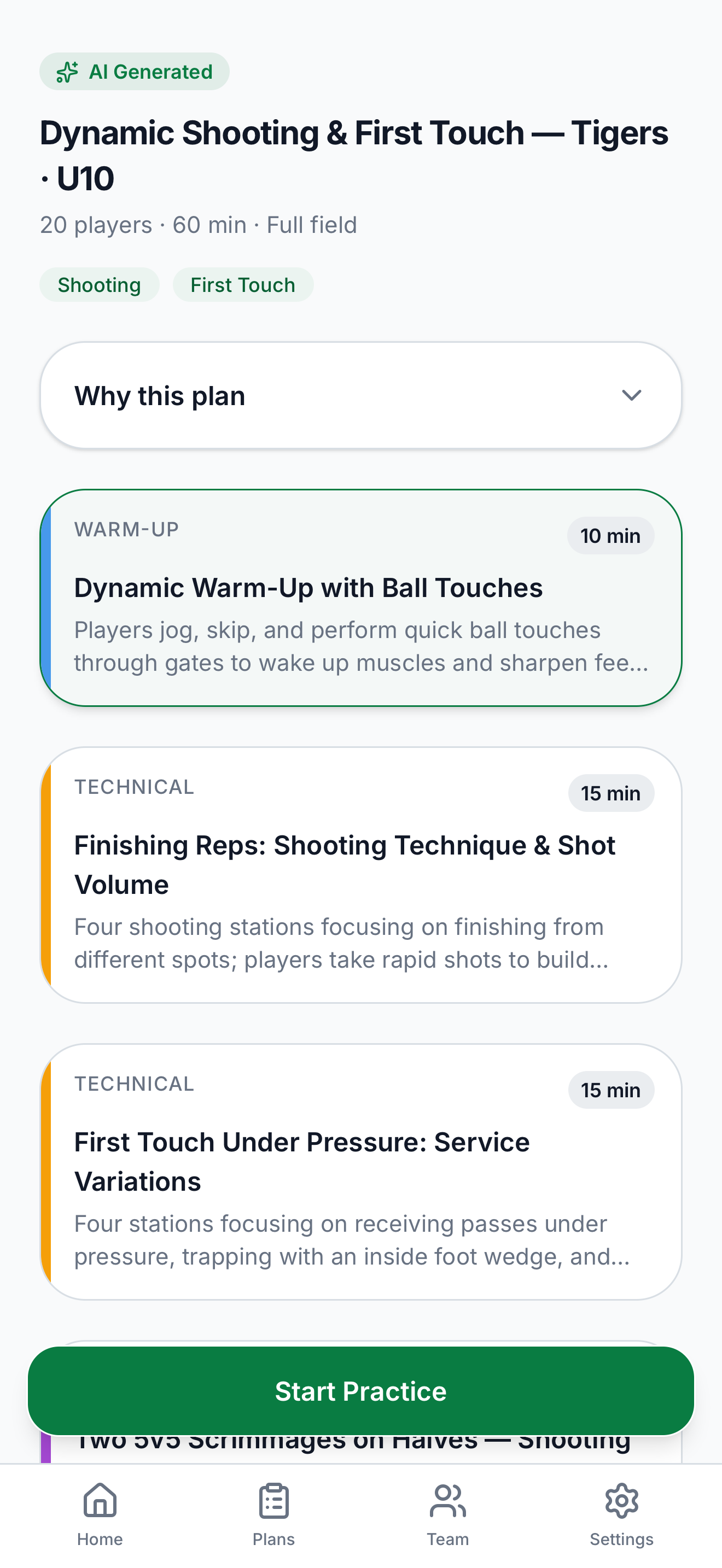
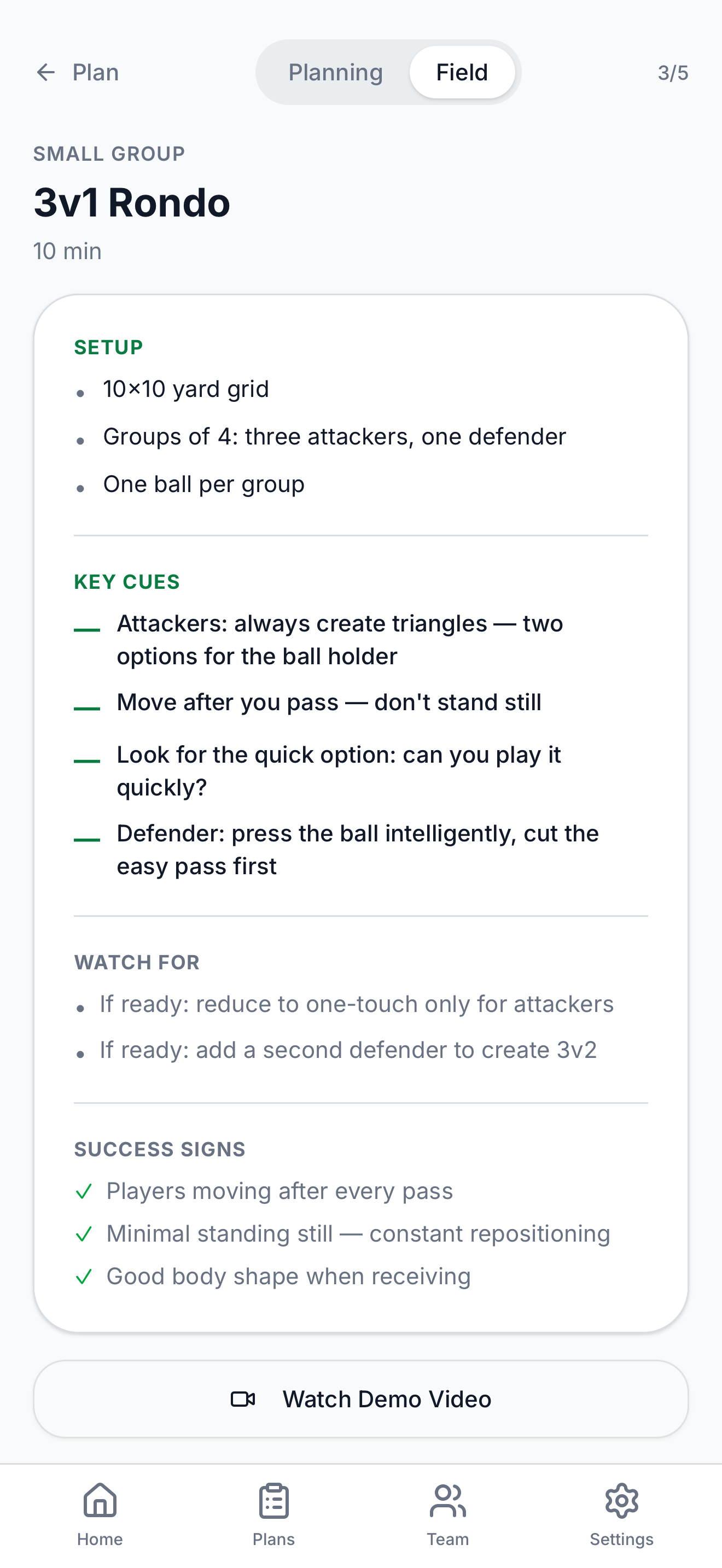
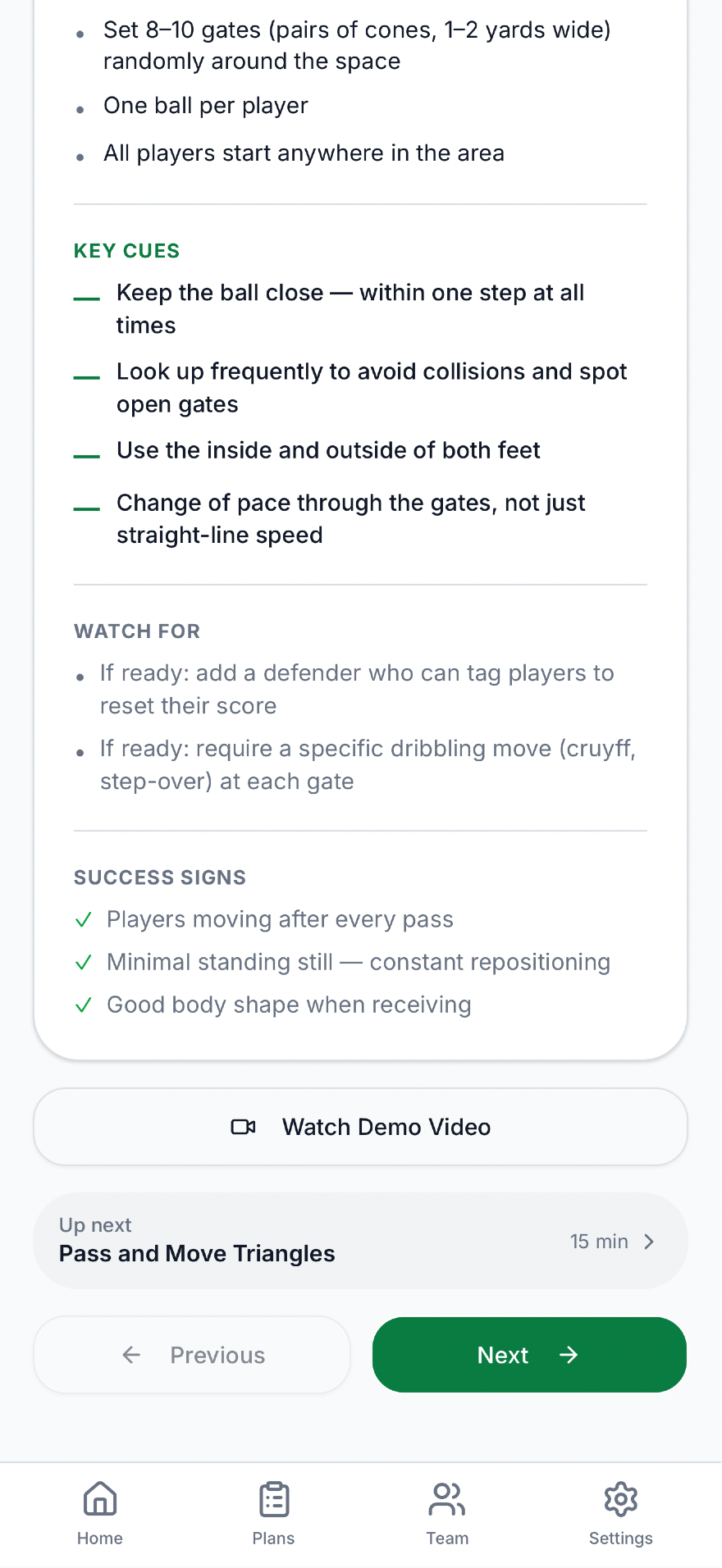
MOBILE VIEWS
- Mobile is optimized for live use, not setup
- Key cues stay visible during practice
- Detail is revealed only when needed
1
2
3
Validation
Validation + Iteration
User feedback highlighted:
- Desire for more control over drills
- Need for clearer coaching guidance
- Importance of adapting during practice
Key adjustments:
- Simplified practice structure
- Improved drill clarity and guidance
- Strengthened pacing and transitions
These changes reinforced a core insight:
Coaches value guidance more than generation.
Outcome
PracticePilot validated that:
- Structure matters more than content volume
- AI is most useful as decision support
- Real-world constraints must shape product behavior
The concept evolved into a system capable of supporting real coaching scenarios, not just theoretical use.
Reflection
This work reframed how I think about AI-powered products
- The challenge was not generating content, but designing a system that:
- Supports decision-making
- Builds trust
- Adapts to unpredictable environments
- It reinforced a principle I apply broadly:
The value of AI is not in what it produces, but in how it helps people make better decisions.
Practicepilot
Designing an AI-assisted coaching tool that helps volunteer coaches run better practices with less guesswork
Volunteer coaches are expected to run structured, engaging practices with limited time, inconsistent player skill levels, and little formal training.
Most rely on scattered drills, past experience, or improvisation. The result is inconsistent practices and low confidence in planning.
PracticePilot explores how an AI-assisted product could help coaches plan, run, and improve practices by turning a few simple inputs into structured, adaptable sessions.
Role
Product Designer
Scope
Product strategy, UX design, prototyping, concept validation
TIMELINE
1 Month
The opportunity
Youth sports are largely run by parent volunteers, not trained coaches.
Common challenges:
- Limited time to prepare practices
- Wide range of player ability
- Lack of structured planning tools
- Pressure to keep kids engaged and improving
Existing solutions focus on drill libraries, not decision-making.
Opportunity:Design a system that helps coaches structure practice time effectively, not just choose drills.
Approach
I framed PracticePilot as a decision-support system, not a content generator.
The goal was not to create more drills, but to help coaches:
- Decide what to run
- Structure time effectively
- Adapt in real-time
- Improve over time
This led to a core product loop that became the foundation of both the product and the experience:
Plan
Inputs → age, players, time, focus
Run
Live practice execution
Revise
Adjust drills, pacing, flow
Improve
Better next session output


Defining the MVP
To keep the product focused and usable, I defined a constrained MVP.
Inputs
- Player age / level
- Number of players
- Practice duration
- Focus area
- Available space / equipment
Outputs
- Structured practice plan with time-based segments
- Drill recommendations aligned to skill level
- Clear pacing and transitions
Platform strategy
- Desktop → planning and iteration
- Mobile → in-practice reference
Out of scope
- Full drill editing system
- Team history and long-term tracking
- Advanced personalization
- Multimodal inputs
This ensured the product prioritized clarity and usability over feature depth.
Key product decisions
01
Structure over infinite generation
Early exploration leaned toward open-ended AI outputs.
This created more friction, not less.
DecisionPrioritize structured practice plans with clear timing and flow.
ImpactReduced cognitive load and made plans immediately usable.
02
Design for real-world constraints
Practices are unpredictable:
- Kids lose focus
- Space is limited
- Time runs short
DecisionAnchor all outputs to real constraints like time, group size, and environment.
ImpactPlans felt realistic and executable.
03
Separate planning from execution
A single experience for planning and in-practice use created friction.
DecisionSplit the experience:
- Desktop for setup
- Mobile for quick reference
ImpactBetter alignment with actual coaching behavior.
04
Trust over novelty
AI-generated outputs can feel inconsistent or generic.
DecisionMake outputs structured, repeatable, and predictable.
ImpactIncreased confidence during real use.
Design execution
PRACTICE BUILDER
- Guided inputs replace blank-page planning
- Real-world constraints shape the output
- Summary confirms what the plan will optimize for
1
2
GENERATED PLAN
- AI output is structured into a real session flow
- Recommendation logic is visible, not hidden
- Save and regenerate preserve coach control
1
2
3
MOBILE VIEWS
- Mobile is optimized for live use, not setup
- Key cues stay visible during practice
- Detail is revealed only when needed
1
2
3
Validation
Validation + Iteration
User feedback highlighted:
- Desire for more control over drills
- Need for clearer coaching guidance
- Importance of adapting during practice
Key adjustments:
- Simplified practice structure
- Improved drill clarity and guidance
- Strengthened pacing and transitions
These changes reinforced a core insight:
Coaches value guidance more than generation.
Outcome
PracticePilot validated that:
- Structure matters more than content volume
- AI is most useful as decision support
- Real-world constraints must shape product behavior
The concept evolved into a system capable of supporting real coaching scenarios, not just theoretical use.
Reflection
This work reframed how I think about AI-powered products
- The challenge was not generating content, but designing a system that:
- Supports decision-making
- Builds trust
- Adapts to unpredictable environments
- It reinforced a principle I apply broadly:
The value of AI is not in what it produces, but in how it helps people make better decisions.
Practicepilot
Designing an AI-assisted coaching tool that helps volunteer coaches run better practices with less guesswork
Volunteer coaches are expected to run structured, engaging practices with limited time, inconsistent player skill levels, and little formal training.
Most rely on scattered drills, past experience, or improvisation. The result is inconsistent practices and low confidence in planning.
PracticePilot explores how an AI-assisted product could help coaches plan, run, and improve practices by turning a few simple inputs into structured, adaptable sessions.
Role
Product Designer
Scope
Product strategy, UX design, prototyping, concept validation
TIMELINE
1 Month
The opportunity
Youth sports are largely run by parent volunteers, not trained coaches.
Common challenges:
- Limited time to prepare practices
- Wide range of player ability
- Lack of structured planning tools
- Pressure to keep kids engaged and improving
Existing solutions focus on drill libraries, not decision-making.
Opportunity:Design a system that helps coaches structure practice time effectively, not just choose drills.
Approach
I framed PracticePilot as a decision-support system, not a content generator.
The goal was not to create more drills, but to help coaches:
- Decide what to run
- Structure time effectively
- Adapt in real-time
- Improve over time
This led to a core product loop that became the foundation of both the product and the experience:
Plan
Inputs → age, players, time, focus
Run
Live practice execution
Revise
Adjust drills, pacing, flow
Improve
Better next session output
Defining the MVP
To keep the product focused and usable, I defined a constrained MVP.
Inputs
- Player age / level
- Number of players
- Practice duration
- Focus area
- Available space / equipment
Outputs
- Structured practice plan with time-based segments
- Drill recommendations aligned to skill level
- Clear pacing and transitions
Platform strategy
- Desktop → planning and iteration
- Mobile → in-practice reference
Out of scope
- Full drill editing system
- Team history and long-term tracking
- Advanced personalization
- Multimodal inputs
This ensured the product prioritized clarity and usability over feature depth.
Key product decisions
01
Structure over infinite generation
Early exploration leaned toward open-ended AI outputs.
This created more friction, not less.
DecisionPrioritize structured practice plans with clear timing and flow.
ImpactReduced cognitive load and made plans immediately usable.
02
Design for real-world constraints
Practices are unpredictable:
- Kids lose focus
- Space is limited
- Time runs short
DecisionAnchor all outputs to real constraints like time, group size, and environment.
ImpactPlans felt realistic and executable.
03
Separate planning from execution
A single experience for planning and in-practice use created friction.
DecisionSplit the experience:
- Desktop for setup
- Mobile for quick reference
ImpactBetter alignment with actual coaching behavior.
04
Trust over novelty
AI-generated outputs can feel inconsistent or generic.
DecisionMake outputs structured, repeatable, and predictable.
ImpactIncreased confidence during real use.
Design execution
PRACTICE BUILDER
- Guided inputs replace blank-page planning
- Real-world constraints shape the output
- Summary confirms what the plan will optimize for
1
2
3
GENERATED PLAN
- AI output is structured into a real session flow
- Recommendation logic is visible, not hidden
- Save and regenerate preserve coach control
1
2
3
MOBILE VIEWS
- Mobile is optimized for live use, not setup
- Key cues stay visible during practice
- Detail is revealed only when needed
1
2
3
Validation
Validation + Iteration
User feedback highlighted:
- Desire for more control over drills
- Need for clearer coaching guidance
- Importance of adapting during practice
Key adjustments:
- Simplified practice structure
- Improved drill clarity and guidance
- Strengthened pacing and transitions
These changes reinforced a core insight:
Coaches value guidance more than generation.
Outcome
PracticePilot validated that:
- Structure matters more than content volume
- AI is most useful as decision support
- Real-world constraints must shape product behavior
The concept evolved into a system capable of supporting real coaching scenarios, not just theoretical use.
Reflection
This work reframed how I think about AI-powered products
- The challenge was not generating content, but designing a system that:
- Supports decision-making
- Builds trust
- Adapts to unpredictable environments
- It reinforced a principle I apply broadly:
The value of AI is not in what it produces, but in how it helps people make better decisions.